Mv To V Conversion Calculator . Use this calculator to convert from dbm to millivolt ( mv) rms. 1 mv = 0.000001 v. Conversion of 2,000 mV to V +> CalculatePlus from calculate.plus 1 mv = 10 6 v = 1000000 v. 1 mv = 10 6 v = 1000000 v. How to convet megavolts to volts.
How To Find Spring Constant Calculator. How do you find the spring constant for a spring? The spring will also grow in length.
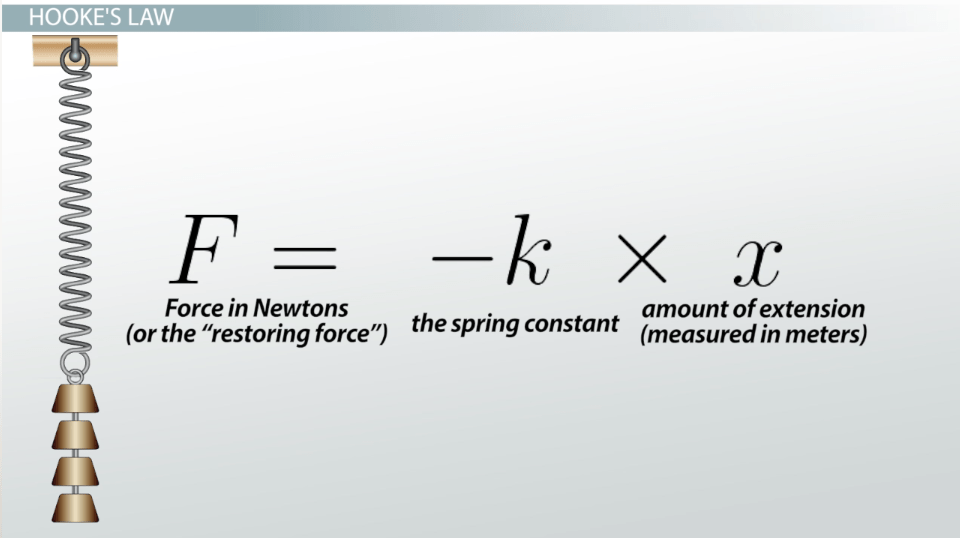
Hooke's Law & the Spring Constant Definition & Equation Video from study.com
Hooke’s law gives the force a spring exerts on an object attached to it with the following equation: X 0 = spring equilibrium position. A 3500 newton force is applied to a spring that has a spring constant of k = 14000 n/m.
Unit Of Spring Constant Is Newton/Meter.
Spring ratings are a constant, example: Calculation do mass and spring constant from the period formula in mass/spring simple harmonic motion. Dove sensitive deodorant stick 29 oct.
How To Find Spring Constant Calculator.
A 3500 newton force is applied to a spring that has a spring constant of k = 14000 n/m. Outputs include spring ratings and spring constant. The spring will also grow in length.
Is Put Onto The Spring The Spring Will Compress Another Inch.
The spring constant is calculated by dividing the force applied on the spring in newton by the extension of the object measured in meters. The variables of the equation are f, which represents force, k, which is called the spring constant and. Whether it is inches (english units), millimeters (metric units), or degrees (for torsion springs).
F Is The Force And X Is The Change In Spring’s Length.
You can use the spring velocity calculator to. X is the displacement of the spring from its equilibrium position; Now that we know that k is the spring constant, we will look at the spring constant.
The Spring Constant Units Are Given As Newton Per Meter.
Spring rate, also known as spring constant, is the constant amount of force or spring rate of force it takes an extension or compression spring to travel an inch of distance or, in the metric system of measurement, a millimeter of distance. As load is applied to a torsion spring, the springs diameter will decrease, reducing the outside and inside diameters. Torsion spring constant design considerations:


Comments
Post a Comment